I said to myself I wouldn't bother to put this tip up on the website... but it comes up over and over on Visordown.com, causes lots of argument and mis-understanding and I find myself answering the same questions over and over... so, to save time here is a Question and Answer primer on countersteering. It's a bit of a long one so if you just want to find out what countersteering is, you can stop after the first couple of questions.
Q - What is countersteering?
A - There are two parts to cornering:
1) To deflect the bike from the vertical you need to countersteer.
2) Once leant over at a constant angle at a constant speed the bike will roll around in a big circle like an ice cream cone.
A motorcycle in motion leans over in corners by balancing the tendency of machine and rider to fall over under its own weight against the centrifugal force which tends to throw rider and machine away from the centre of the corner. To maintain the lean, the motorcycle must continue to follow a curved path by turning towards the direction it is leaning. For a fixed radius of turn, there will be only one lean angle that matches a particular speed.
But to reach that lean angle in the first place, if you want to lean over further or pick the bike up again, you have to make a countersteering input.
How does countersteering work? Well, contrary to popular opinion, gyroscopic forces are not the answer - they contribute (and are easy to demonstrate) but the major forces (some 30 to 40 times stronger) are inertia and camber thrust. Turning the front wheel to one side (we'll say to the right) has several effects:
* the machine will turn around the point where lines drawn through the wheel spindles of the front and rear wheels cross each other (intersect)
* the effect of trail moves the contract patch of the front tyre to one side, so that the centre of gravity of the bike is no longer directly above the line on which the bike is supported between the tyres - the bike will fall to one side
* the effect of caster steering makes the front wheel lean, so that the contact patch is no longer on the centre line of the steering, and tries to turn the tyre into the corner - this is known as camber thrust
The upshot of all this is that inertia wants the bike to carry on in a straight line but camber thrust wants the tyres to turn in a tight circle to the left (roll a loose tyre to see the sort of size of the circle. The force generated by the camber thrust is not strong enough to overcome inertia and make the bike turn in the tight circle it would like but it is sufficient to give the bike an acceleration to the left. The final "set" which the bike settles into differs from machine to machine and may or may not demand rider input and depends on steering geometry, tyres, road surface etc. etc...
That (leaving out all the maths!) is what happens in a nutshell.
So again, countersteering gets you into and out of an angle of lean, leaning the bike over makes it follow a curved path.
Q - Why is it called countersteering?
A - Because you are applying a force to the bars which turns the front wheel right to go left, and turns it left to go right! The easiest way to remember what you need to do is that you need to PUSH the side of the bars in the direction that you want to go - ie you PUSH the LEFT handlebar to go LEFT, and the RIGHT handlebar to go RIGHT. For this reason it is sometimes called "push" steering.
OK, if you want, you can stop there because that really is all you need to know! But if you want to see the sort of questions that people ask about steering, read on!
Q - Someone said that countersteering works on any bike. Does this include Speedfight 50's, because I'm buggered if I can do it?
A - Countersteering works on any two wheeler. You simply turn the bars opposite to the direction you wish to turn. This is usually done by pushing on the inside bar, but I sometimes do it by pulling on the outside bar if I am riding one handed, and want to turn left. Beware scooters and other lightweights though, they steer very fast!
Q - Do you push DOWN on the bar, or AWAY from you or what? All my bike does is go the wrong way.
A - First off, push AWAY, don't push DOWN on the bars - you need to turn the steering around the pivot point of the steering stem. Think what plane the bars move in - if you push down you only try to bend the handlebar. Try pushing down on the handlebar of an XV535 Virago - its almost impossible because the bars are almost at shoulder height. Push away gently on the left handlebar and the bike will lean and swerve to the left. Push away gently on the right handlebar and the bike will lean and swerve to the right. What happens when you release the push on the bars? You'll find the bike will either stay on the curved path you have set it and continue to corner, or will tend to sit upright - this latter is a self-correcting effect often designed into the steering.
Q - At what speed must one countersteer to turn a bike?
A - Countersteering works at speeds above walking pace. The faster you go, the greater the forces needed to steer the bike. At 20, you will barely be aware that you are doing it. When I do countersteering demos, I usually run at around 20mph and a very gentle push is all that is needed, so on a reasonably light and agile bike, up to about this speed you really don't have to use much muscle at all, any big push on the part of the rider will have the bike changing direction very violently, enough to lose control. By contrast at 100 you will have to work quite hard to steer.
Q - How do you actually do it though, from the sounds of things you just turn the bars the 'wrong' way a bit. Any advice on where/how to practice?
A - Find a straight, empty road or large carpark - you really need around 50 metres minimum length for this, so an EMPTY carpark is ideal. Don't try it when Sainsburys is busy or down your local high street.
Get up to a reasonable speed - around 20 miles per hour is fast enough for a first attempt if you are in a car park - use the gears, if you hang onto first gear and shut the throttle you'll get a big wobble with engine braking. Don't try this too fast to start with, brace your knees against the tank, a reasonable grip (not a death grip) on the bars and keep you elbows loose.
Remember - the amount of effort needed to turn the bike at low speeds is negligible, nor do you need to turn the bars very far. Make sure you use a VERY GENTLE push - the amount of force you need to apply is in the order of the amount you need to push an empty beer bottle over - not very much.
Just use one push on the first few runs so you can learn how much force to use. Practice doing this a few times until you start to get the feel for it. Increase the speed (if you have room) and feel how the effort needed gradually increases.
When you are comfortable with the amount of effort involved, only then try to slalom. Use the painted white lines or something similar (I use skateboard cones from Toys R Us) - don't try to slalom round solid obstacles like cars!!!. This is a valuable exercise to repeat regularly or when you get a new bike to ensure you can steer accurately.
Next find a nice straight clear road and try countersteering in a gentle slalom. Don't frighten car drivers by doing it in front of them. As you get more confident, you'll be able to swerve the bike harder and harder or at higher speeds. It's much easier to experiment like this than actually in bends, which should come once you've got the feel.
Finally to get the feel for countersteering in a bend, find a corner you know well, with a good clear view, not too fast and not too slow - something in the 30 -50 mph range is ideal. Ride round it a few times just to refamiliarise yourself at a speed and using a line that feels comfortable, and away from the extremes of the kerb and the white line - remember we are trying a new technique and need leeway for errors.
Finally try countersteering into the bend. Make sure the road is empty, and your posture is nice (elbows loose, knees gripping the tank). Approach the corner as normal, getting your braking done in a straight line before you get there to get the bike settled. At your normal turn-in point, actively countersteer (remember the provisos above about the degree of turn and amount of effort needed) until the bike is at the lean angle you need to negotiate the corner. You'll almost certainly find that you turned along a much tighter line than you expected (hence the advice to only do in a bend where you can see there is no traffic).
Once the bike is turning, you should only need a light grip on the bars, and no real steering input. Remember to turn in on the power, and to keep the power on gently through the corner.
Q - I can honestly say that I have never consciously countersteered in my life and, so far at least, I seem to have survived
A - Well, whether you think you do, or think you don't, you do. It's because the amount of deflection that you make at the bars at average speeds and average lean angles is tiny and very short lived, so unless you are consciously looking for it, almost indetectible. Remember, countersteering initiates the turn by getting the bike over off the vertical. Once leant over the bike rolls round like a great big ice cream cone.
Q - The notion of deliberately turning the bars in the opposite direction going round a tight bend is just not on
A - Like any new technique it should be approached cautiously. If you don't want to try out and practice yourself on the basis of what you've read and possibly not fully understood on a web-site (and I can understand that), then have someone there actually to show you how. Any competent instructor should be able to explain and demonstrate countersteering.
Q - I tried countersteering once and scared myself silly - I nearly lost control
A - it sounds like you have pushed too hard in the past and scared yourself! I did the demo week in, week out on a GS500 on DAS courses... then one day I had to use my Dominator - with the big wide bars and light steering. Without thinking, I used the same amount of force and nearly pitched myself off!
At around 20mph, a very gentle push is all that is needed, so on a reasonably light and agile bike, upto about this speed you really don't have to use much muscle at all, any big push on the part of the rider will have the bike changing direction very violently, enough to lose control. Hence my warnings above to take it by stages. So take care trying the theory out in practice!
Q - I'm inclined to continue to rely on my instincts - if it ain't broke don't fix it!
A - Don't you think you might improve your riding if you were fully in control of what you do?
Aside from sharpening up your lines around corners and giving you more space to steer round them in, countersteering is also very useful is making the transition from upright to full lean angle VERY quickly, which if you consider it is a good "get you out of trouble" skill. It's useful when mid corner you realise the bend is tightening up - countersteering more can stop you running wide.
Riding by instinct is what I did for the first five or six years of my 20+ on bikes... learning about countersteering (and other ways of steering the bike) changed the way I rode dramatically - and reduced the number of car/bike interface situations too!.
Q - Nobody worried about this countersteering malarkey when I learned to ride 30 years ago, and it was never taught on training courses. I reckon it only applies to those bum in the air plastic crotch rockets
A - The physics behind countersteering apply to all bikes, regardless of age. Older bikes with 19" wheels and narrow tyres handle differently to modern sports bikes, but then so do modern trail bikes. Countersteering has been known about since the 20's, the physics first investigated in the 50's and properly described in the 60's and 70's. It's been the subject of magazine articles since the late 70's which is when I discovered it. I do teach it now on DAS courses because it helps trainees understanding of steering, and cuts down the amount of time needed to get them to ride the bigger DAS bikes at a decent standard.
Q - Most of the time I'm riding I don't think about countersteering. Am I doing something wrong?
A - You're quite right in that 90% plus of the time I'm riding I never give countersteering a thought either...
Where it comes in most useful is as a highly practical road-riding (as opposed to track) skill when you arrive in the midst of an "oh shit" situation. Then understanding and being able to use countersteering positively is a huge plus point.
It's like being able to brake to the point of locking the front brake at will - its not something I do in everyday riding, but just every now and again it comes in useful.
Learning new skills is all about giving yourself that little bit of an edge. But I quite take your point about not doing it on the advice contained in a website - to be perfectly honest given the amount of discussion and partial disagreement this subject always raises, I'd be a bit wary too.
Q - So what advantages are there to countersteering?
A - Once you know how it works you can choose whether to use it consciously. If you do, it'll allow you to brake later and keep the bike upright for longer in the turn, thereby allowing you to see further through the turn. It'll allow you to get the bike upright sooner, and get back on the power earlier, getting better drive out of corners. Not least it allows you the option to keep away from potentially dangerous extremes of position to either side of the road - in other words it gives you more space to choose from on the road.
As regards speed, between about 20 and 50 you can improve your turning with a positive decision to use countersteering - you can still turn without feeling what you are doing or thinking about it, but by using countersteering you will improve both the speed at which you get the bike to full lean and also your placement in corners... this is what I mean by medium speed, but the forces you have to apply are still fairly small..
Over 50 you are now having to turn the bike fairly quickly to get round bends on anything other than motorway or Roman road, so you need positive input, and of course the forces are increasing... by now you are starting to notice that you are actually doing physical work, particularly if you are riding a bike that doesn't turn easily... this is what I mean by high speed, and now actively deciding to countersteer has huge benefits in terms of control...
Clearly these figures are guestimates, and depends on bike, road, loading etc. etc., and there is obviously no real boundaries but I think you will get the idea...
Q - So do you do anything else in corners apart from countersteer?
A - Another important factor in cornering is throttle control. Don't coast round bends, but gently put the power on all the way through the bend, this will stabilise the bike.
Don't forget posture and relaxation. Many riders are far too stiff. Relax your elbows and upper body, make yourself flexible and brace your knees against the tank. And remember not to negate your steering effort by pushing on the other side of the bars at the same time.
Q - So how do we use countersteering with braking and acceleration?
A - It works with the standard technique for taking corners which is elsewhere on the site. As soon as you see the next corner you should :
* Set your position in the road
* Sort out your speed, braking in a straight line if necessary, and getting in the right gear
* Countersteer
* Drive through and out of the corner with the throttle
Q - I steer by leaning into the corner
Sorry - almost impossible! Keith Code has built a bike with a second pair of fixed bars to prove this, a report on which you can find (at least as I write) at
https://www.popularmechanics.com/popmech/out/0102BOODWFAP.html
If you cannot turn the bars physically around the axis of the steering stem, and can only apply left-right/up-down pressure on the footpegs or bars, you are trying to move the mass of the bike via a simple lever about the pivot point of the tyres' contact patches. A bit of basic Newtonian physics will show that if the effect of that pressure is to make the bike lean off the vertical, which you can only do by leaning your body in the OPPOSITE direction - equal and opposite forces/action and reaction. Peg weighting does exactly the same thing.
Now precisely what happens at that point that the bike shifts off the vertical is the interesting bit. Because the wheels are not fixed in line but free to pivot around the steering head, the result is that the bars turn at least momentarily in the opposite direction, before turning slightly into the corner as the bike rolls round in a circle. Which when you think about it is not a huge surprise, because if the turning forces applied by countersteering (a torque) serve to shift the CoG to the side of the line joining the contact patches, shifting the CoG to the side of a line joining the contact patches must apply a torque to the steering.
So at the risk of offering up a rather pathetic pun, the wheel has turned full circle.
Peg weighting/bar pressuring uses the same fundamental dynamics of motorcycle design as countersteering.
The fundamental difference is the forces involved. If you steer by bar pressure/peg weight, you can only apply a force at its greatest equal to your body weight to move the mass of the bike left/right. Weighting the pegs offers very little mechanical advantage because you are applying the force very close to the "hinge" of the tyres' contact patches. Pushing the bars applies more because the force is applied much further from the "hinge". Imagine trying to push a wine bottle over - its a lot easier if you do it near the cork than it is down by the bottom of the bottle.
There is also a serious drawback - as the bike gets heavier (or the rider lighter) the amount of force you can apply in this way decreases - think of the effort needed trying to push over that bottle when it is full and after you have drunk the wine.
Countersteering, by contrast, generates a lot of mechanical advantage because the lever is the handlebars and it is hinged in the middle at the steering stem. This means you can both PUSH and PULL on the bars at the same time and the leverage you can apply is limited only by muscular strength.
There are also leverage effects in the caster design of the wheel and steering itself which I haven't even begun to think about, but this is why a bike like an 1800 Goldwing weighing over 400kg can still turn corners. It will never be as quick to roll from the vertical as a 85kg 125cc GP bike but by using wide bars which generate a lot of leverage, and an advantageous design of the steering, it can still be reasonably agile.
The important point is not that peg weighting/bar pressuring doesn't work (because it does) but the rate at which the bike rolls off the vertical. It really is very slow by comparison with countersteering. The message is:
If you want to steer fast, countersteering is the way to go.
So, lots of experienced riders actually claim they turn by leaning, but almost certainly as they lean into the corner, they actually give the steering a little nudge, so countersteering unconsciously.
Q - I steer by weighting the footpegs
See the above paragraph for the physics, but there is another consideration. Pushing on the bar or the footpeg to steer can in no way move the COG of the combined bike or rider if you sit rigid in the saddle - the only way it can work as a technique is if you let the bike "hinge" beneath you by lifting yourself out the seat or by bending from side to side at the waist. When you do this you will find that you do it by flipping your body in the opposite direction - equal and opposite forces as already explained.
Try pushing down on the footpegs of a XV535 - Peg weighting and pushing down on the bar only really works on a bike where the foot pegs are more or less directly beneath you. It is a technique limited by ergonomics.
As mentioned, the main problem with this technique is that you are trying to move a lot of mass of bike with relatively little mass of rider and little leverage. It works well enough on lightweight race bikes, but my GSXR750 at something over 200kgs and a steering damper, barely budges off the vertical. Countersteering gives you access to much greater forces.
Where weighting the pegs or pushing the bars does help is to reduce the mass that has to be moved from one lean angle to another, by taking the mass of the rider out of the equation. The bike leans, but the body of the rider effectively stays still. Thus the bike can move from one lean angle to another more quickly, hence its use in racing and quick collision avoidance swerves on the road.
Q - Turning the bars the opposite way will make the bike very unstable and it's actually hard to do at speed. Pressing the footpeg and applying slight downward pressure to the bars will steer the bike with the minimum of fuss. It also puts weight lower down in a turn
A - Right, first off, putting weight on the pegs has no effect on the combined centre of mass of bike and rider because your body mass is still in the same place relative to the mass of the bike, so it cannot move "weight"! The only way you can do that is to sit upright or crouch down (or hang off In a corner). What it does do as explained above is apply some turning leverage to the mass of the bike.
Yes, the amount of effort you need to put through the bars to countersteer increases dramatically at speed. At lower speeds, if you apply too much force, it is possible to make the bike go unstable. Like any muscle activity, as you increase the amount of force you apply, so your muscular CONTROL over that force decreases (like turning a nut - if its only lightly held you can turn it out smoothly and steadily, but if it's stuck, when it finally goes it usually results in bloody knuckles), so this is a good reason to practice smooth (not necessarily slow) steering manoeuvres.
Q - These techniques are race stuff. Countersteering is something you only do on trackdays and sportsbikes.
A - I disagree. The more skills you understand and can use, the better. It doesn't mean that your knowledge obliges you to ride fast, but if a corner tightens, or you need to avoid a Volvo, then the techniques to change direction hard and in control are very useful.
Q - So countersteering is the only technique to use in corners?
A - No, that's too simplistic too. Countersteering works as a stand-alone technique. It's by far and away the most important, and the other techniques are very relevant and complementary, but only when used in conjunction with countersteering.
Used together, they put you in full control of steering.
Q - One thing I don't understand: the faster you're going the more you need to countersteer; but at low speeds, you don't countersteer. Does this mean that there is a certain speed at which steering has no effect or has an unpredictable effect because it's too fast for "normal" steering and too slow for countersteering?
A - The maths shows that for a conventional bike countersteering works from about 5mph upwards. By about 20mph, the forces needed to countersteer are big enough for you to be able to feel them and steer smoothly (the forces below about 20 are so small that it's difficult to steer smoothly and light bikes with wide bars make it more awkward still due to the small mass and increased leverage). By the time you get up to 100mph+ you need serious muscle to turn the bike fast.
Q - I understand countersteering and use it all the time - but I find when the bike is leaned over I have to keep a force applied to the bars to keep it on line
A - This is down largely to steering geometry and tyres and you will feel this as whether the bike naturally oversteers, understeers or is neutral steering in corners. Remember I mentioned the bike taking a "set" earlier - this is what I was talking about. Most modern bikes are set up to understeer, so that you have to keep a small amount of steering effort applied to hold a steady line against the bike's natural tendency to straighten up. Some of the 80's 16" front wheel bikes oversteered - they used to flop into corners and felt very unstable indeed at low speeds. As the speed goes up, the self stabilising effect usually increases so the bike feels more stable when turning.
Q - Somebody told me I need to oversteer into a corner if it tightens
A - Confusion of terms! The main thing to remember is that to ALTER the lean angle of a bike either in the initial turn-in phase of cornering or mid turn use a technique we call countersteering. What we call oversteer (or understeer) is the tendency of the bike to deviate from a CONSTANT turn radius constant. This is a result of a whole mess of forces operating on the tyres and the geometry and design of the bike. You may still be applying a force to maintain a constant radius turn, but it is not called countersteering! For example, if you are pushing the left bar through a left turn to keep the bike on line, you are correcting for UNDERSTEER - if you didn't the bike would run wide in the turn.
Q - You tried hanging off and countersteering?
A - Yes, and it still works. In fact, in my opinion it puts you into a better position to countersteer because hanging into the corner gives you more leverage on the inside bar.
Q - This is all too much for me - my head hurts
A - These things are much easier to demonstrate that to explain sat at a PC. If you are anywhere near Maidstone or Oxford, give me a call on 01622 862910 or mail me, and I'll organise a countersteering workshop! And see you down the pub later!
Q - But all we really have to know is that we push left to go left and push right to go right. Correct?
A - Correct - which is why I said you could stop reading after the first two paragraphs, so well done if you got this far. Countersteering is a fundamental bike control technique, and from a purely practical point of view, about as straightforward a technique as anything else we do whilst sat on contradictory, non-intuitive motorcycles. It ought to be as automatic to riders as using the brakes properly.
Unfortunately because the theory is not straightforward, it's easy to overcomplicate it to the point of confusion. Whilst theoretical discussions and the finer points of peg weighting and all the rest are fine for those interested, we risk losing a large part of our audience by getting too technical.
Q - Haven't we done this all before?
A - Yes, many times, here and everywhere else, and we no doubt will again. There are still plenty of riders who don't know how they steer a bike!


 Help & FAQs
 Search BCF
 Members
 Groups
 Events Calendar








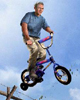


 Eyes. Keep your eyes up and look as far down the road as you can. Your bike will naturally want to go where you are looking, and you will find that you will be faster without any effort. It sounds really odd, but you need to look past all of the other traffic, past the obstacles and through to the furthest away bit of road. You may occasionally scan back towards your front wheel with your eyes, but don't *try* to do this as you will do it subconsciously anyway. Keep your eyes up!



 rating
 rating