|
|
| Author |
Message |
| Gazz |
This post is not being displayed .
|

Gazz
World Chat Champion
Joined: 19 May 2009
Karma :  
|
|
| Back to top |
  |
You must be logged in to rate posts |
|
 |
| Kwaks |
This post is not being displayed .
|
Kwaks
I'm not a fast rider

Joined: 28 Jan 2006
Karma : 
|
 Posted: 22:32 - 22 Dec 2011 Posted: 22:32 - 22 Dec 2011  Post subject: Post subject: |
 |
|
quicker turning
____________________
Fallen Angel "Nae sniffing my seat now!!!!! "
www.cliqueycuntsmcc.co.uk
I AM NOT A FAST RIDER!!!!!!!!! |
|
| Back to top |
 |
You must be logged in to rate posts |
|
|
| MarJay |
This post is not being displayed .
|
MarJay
But it's British!

Joined: 15 Sep 2003
Karma : 
|
|
| Back to top |
| |
You must be logged in to rate posts |
|
|
| stinkwheel |
This post is not being displayed .
|
stinkwheel
Bovine Proctologist

Joined: 12 Jul 2004
Karma : 
|
| Posted: 11:42 - 23 Dec 2011 Post subject: |
|
|
Mostly fashion.
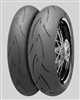
The wheels are the same size on most road bikes. Modern standard is 17". There was a fad for 16" wheels at one point and older bikes had 18" or even 19".
In order to be different, a lot of track bikes are now using 17.5" tyres. They'll give you all sorts of reasons why it's the best thing ever and scientifically worked out, but so were 16" and 17" tyres in their day. Nobody would touch a 16" wheel now because they are "too unstable" . In 1985 they were the dogs danglies because they "Turn in quicker.".
The front looks smaller because of the tyre profile a 120/70 will be adding 168mm to the diameter and a 160/60 will be adding 192 to the diameter. Making an effective front to rear difference of 24mm to the outside of the tyre. This has more to do with profile than the diameter in terms of practicality. ie, how round it is in cross section.
There was a period where a small rear and a bigger front was in fashion (say 16 rear, 19 front).
As has been said, larger wheels are preferred on offroad bikes because they can bump up over rocks and out of potholes more easily. So nowadays you usually get a 21" front and a 17" rear. There was a period where 23" fronts were all the rage. Odd how they do the exact opposite with mountain bikes. Technically, a racer wheel should be better at bumping up over kerbs although there is a growing move towards 29" mountain bike wheels.
The best bit though, is how they give the diameter in inches and the width in millimetres. I love that.
____________________
“Rule one: Always stick around for one more drink. That's when things happen. That's when you find out everything you want to know.”
I did the 2010 Round Britain Rally on my 350 Bullet. 89 landmarks, 3 months, 9,500 miles.
Last edited by stinkwheel on 11:50 - 23 Dec 2011; edited 1 time in total |
|
| Back to top |
| |
You must be logged in to rate posts |
|
|
| Blau Zedong |
This post is not being displayed because the poster is banned. Unhide this post / all posts.
|
Blau Zedong
Banned

Joined: 26 Jun 2006
Karma : 
|
|
| Back to top |
| |
You must be logged in to rate posts |
|
|
| Wafer_Thin_Ham |
This post is not being displayed .
|
Wafer_Thin_Ham
Super Spammer

Joined: 18 Nov 2005
Karma :
|
|
| Back to top |
| |
You must be logged in to rate posts |
|
|
| stinkwheel |
This post is not being displayed .
|
stinkwheel
Bovine Proctologist
Joined: 12 Jul 2004
Karma :
|
|
| Back to top |
| |
You must be logged in to rate posts |
|
|
| Blau Zedong |
This post is not being displayed because the poster is banned. Unhide this post / all posts.
|
Blau Zedong
Banned
Joined: 26 Jun 2006
Karma :
|
|
| Back to top |
| |
You must be logged in to rate posts |
|
|
| P.addy |
This post is not being displayed .
|
P.addy
Red Rocket
Joined: 14 Feb 2008
Karma : 
|
|
| Back to top |
| |
You must be logged in to rate posts |
|
|
| G |
This post is not being displayed .
|
G
The Voice of Reason
Joined: 02 Feb 2002
Karma : 
|
|
| Back to top |
| |
You must be logged in to rate posts |
|
|
| Blau Zedong |
This post is not being displayed because the poster is banned. Unhide this post / all posts.
|
Blau Zedong
Banned
Joined: 26 Jun 2006
Karma :
|
|
| Back to top |
| |
You must be logged in to rate posts |
|
|
| Kickstart |
This post is not being displayed .
|
Kickstart
The Oracle

Joined: 04 Feb 2002
Karma :
|
|
| Back to top |
| |
You must be logged in to rate posts |
|
|
| stinkwheel |
This post is not being displayed .
|
stinkwheel
Bovine Proctologist
Joined: 12 Jul 2004
Karma :
|
|
| Back to top |
| |
You must be logged in to rate posts |
|
|
| Gothtec |
This post is not being displayed .
|
Gothtec
Renault 5 Driver
Joined: 14 Dec 2011
Karma :  
|
| Posted: 14:34 - 23 Dec 2011 Post subject: |
|
|
Nothing like a big fat rear tyre on a bike.... 
____________________
---------------------------------------------------------------------------------------------------------------
10% discount at www.globalbikeonline.com, use promo code gboaw10 at the checkout!
--------------------------------------------------------------------------------------------------------------- |
|
| Back to top |
 |
You must be logged in to rate posts |
|
|
| G |
This post is not being displayed .
|
G
The Voice of Reason
Joined: 02 Feb 2002
Karma :
|
|
| Back to top |
| |
You must be logged in to rate posts |
|
|
| stinkwheel |
This post is not being displayed .
|
stinkwheel
Bovine Proctologist
Joined: 12 Jul 2004
Karma :
|
|
| Back to top |
| |
You must be logged in to rate posts |
|
|
| Rogerborg |
This post is not being displayed .
|
Rogerborg
nimbA

Joined: 26 Oct 2010
Karma :
|
|
| Back to top |
| |
You must be logged in to rate posts |
|
|
| P.addy |
This post is not being displayed .
|
P.addy
Red Rocket
Joined: 14 Feb 2008
Karma :
|
|
| Back to top |
| |
You must be logged in to rate posts |
|
|
| G |
This post is not being displayed .
|
G
The Voice of Reason
Joined: 02 Feb 2002
Karma :
|
|
| Back to top |
| |
You must be logged in to rate posts |
|
|
| Pete. |
This post is not being displayed .
|
Pete.
Super Spammer

Joined: 22 Aug 2006
Karma : 
|
|
| Back to top |
| |
You must be logged in to rate posts |
|
|
| 1cyl |
This post is not being displayed .
|
1cyl
World Chat Champion
Joined: 04 Feb 2004
Karma :
|
| Posted: 20:19 - 23 Dec 2011 Post subject: |
|
|
|
|
| Back to top |
| |
You must be logged in to rate posts |
|
|
| Teflon-Mike |
This post is not being displayed .
|
Teflon-Mike
tl;dr

Joined: 01 Jun 2010
Karma :
|
| Posted: 20:40 - 23 Dec 2011 Post subject: |
|
|
Following Stink's diagram & explanation:
The bigger a wheel the smaller the ramp angle over any obstacle, so it has less 'rolling resistance' to an uneven surface. Think about a car wheel vs a shopping trolley accross a car-park. So off-road tackling rougher, more uneven terrain, bigger the wheel the better.
Bigger wheels also turn fewer RPM for same road speed, so less friction in the bearings.
We then get to the flywheel effect. Wheels act like flywheels; they have weight, and the bigger and or heavier and or faster they turn, the more flywheel effect they give.
Bigger wheels will have more mass at the rim, and it will be further from the axle so for the same revs they will have more flywheel effect. This helps them keep turning, but also helps give the bike more 'stability' from what for simplicities sake I will allow as the 'gyroscope' effect.
BUT, it's a three way dynamic; small wheel turns more rpm for same road speed, so you can get a lot of flywheel effect from a smaller wheel turning faster, compared to a bigger wheel turning slower.
On smaller lighterweight machines, though, the optimum favours bigger wheels; the machine not having much mass in the rest of the machine to give the vehicle extra stability.
As bikes get heavier and the ratio of bike mass to wheel mass increases, so the 'optimum' wheel size starts to fall, more stability coming from the bikes weight rather than the gyroscope effects.
NOW: slight asside, dirt bikes, often LOOK like they have hugely over sized front wheels. The regulation 'control-tyres' for trials state a 2.75x21" front tyre, and 4.00x18" rear.
The 2.75, or 4.00 is the width of the tyre, in the old imperial system. Its the tread width in inches. or more exactly the diameter of the tube inside.
Tubed tyres, you have a round section 'donut' of a tube, the tube being as tall as it is wide. So if the circle is 4" in diameter, that gives a 4" 'width' to the tyre, but also gives a 4" height, on top of the wheel rim.
SO, your 18" rear wheel with a 4" tyre has a 'rolling' diameter of 18" + 4" of tyre side wall on top, and another 4" of tyre side wall on the bottom, = 26"
Your 21" front has 2&3/4" of tyre top and bottom... 26&1/2" near enough the same overall diameter as the rear.
Off-Road bikes TEND to be lighter, they tend to also be slower, AND they tend to be riding over more uneven surfaces, so its all 'good'.
Now, in days of yore; road bikes had big wheels, for the same reasons. Roads weren't as 'good' as they are today, and suspension systems far less sophisticated, so they needed 'stability' and faster they went, more stability they wanted.
Old bikes of the 1950's & 60's would often run 21" wheels with something like a 2.50 section tyre front and back.
And in the hey-day of trials, fitting a smaller back wheel to allow a wider rear tyre with lower ground pressure so it didn't sink into the mud as easily, saw the rear wheel diameter's reduce.
For road bikes they came down incrementally, with less differential in tyre sizes, front to rear, to 'about' 18" with possibly a 3.50 or 4.00 section tyre, common by the 1970's.
Same time, bikes speed and weight were going up, dramatically with the trend towards four cylinder engines. Tyres, and suspension were barely keeping pace with them. This lead to a lot of experimentation in the 1980's and the vogue Stink has mentioned for 16" front wheels.
If you have ever ridden an old dirt bike on the road at speed, and given a hefty tug on the bars, you can notice a few curious things; first, takes a lot of effort to make the bike steer, second, possible to watch the forks twist in relation to the wheel, which that big, and turning that fast really doesn't want to respond to the change of direction asked for.
SOME of this is due to the geometry of the bike's steering, the forks tend to be quite significantly raked out, like a chopper, because this can give good stability, but the other is the amount of 'trail' the distance the tyres contact patch lags behind the point that the steering axis would intersect the floor. Bigger the wheel, and the more rake you have, further ahead of the contact patch this would tend to be.
Smaller the wheel, steeper the forks, less trail you get, which is why some small wheel scooters have forks that look like they are fitted back-wards with the axle behind the fork, like the castor on a shopping trolley!
'leading axle' forks, that have the wheel axle on the front of the fork slider, are actually to reduce the trail, on a big wheel and make the steering 'lighter'... but on an old trail bike, exaggerate the effects road bikes suffered; heavy, unresponsive steering, and fork flex.
So, if you can reduce the weight and the 'stability' of whats hung on the end of the forks, got to be good; means you dont need as stiff and heavy forks, or for the same weight & stiffness the forks, you can get easier and more responsive steering to the wheel.
Bikes were also getting faster, and heavier, and fitting fatter tyres would seem a good way to react higher loading.
An 18" wheel, with a 2.50 section front tyre on it. it's 23" in rolling diameter. Up that to a 3.50 section, your wheel now has a 25" roling diameter, giving more gyrospic effect.
But, drop the rim diameter to 16"? 16+3.5+3.5 is 23", same as 18" wheel with narrower tyre.... AND the heavier bit of the wheel, the rim, is now closer to the axle, so lower moment of inertia, less flywheel & gyroscope effect, AND probably less overall weight too.
So the wheel diameters came down, to accomodate wider tyres, and give this 'faster steering'.
Overall stability could be maintained in the bike, changing the steering geometry and keeping mass in the main body of the bike. Common in that era was a 16" front wheel, but 18" rear, to keep the stability that offers in the main 'mass' of the bike.
A lot of critasism of 16" front wheel bikes has been offered over the years, little of it actually due to the wheel or the tyre sizing on it. Most of the critasisms are actually to do with the overall dynamics of the bike, and it was an evolutionary era; the manufacturers didn't always get it 'right'. And many early 80's bikes with 16" front wheels also got what would now be considered incredibly conservative steering geometry, to compensate for the 'idea' that the small front wheel would make the bike 'twitchy' or it was.
As the decade progressed, the trend towards race replica's saw bikes with shorter forks, and much thicker, stiffer forks, and increasingly more 'nose' biased weight distribution, and an actual desire for more 'twitchy' responsive steering.
Result was, that as the design of the bike evolved over the decade, the reasons for fitting smaller front wheels were sort of deminished by other changes in the overall design.
The modern 17" wheel becoming the new 'standard' through the 90's for a road bike, fitted with modern 'radial construction' tubless tyres, that were a lot more sophisticated than the old tubed cross-plies or old, and tubless construction offering the benefit that the side-wall DIDN'T have to be the same height as the tyre width...
All of a sudden, tyres could be made as wide as you wanted (pretty much) for the same amount of side wall.... the 'low profile' tyre.
The old 1970, Honda CB750 'Four' had a 19" front tyre with a 3.50 section tyre. My 1993 CB750, has a 17” rim with 120/70 section tyre.
Interpreting that number; the modern ‘metric’ sizing gives the tyre width, 120 in mm, then the profile, / 70, denoting that the sidewall is 70% the tyre width, so 120 x 0.7 = 84mm.
That puts the front wheel of my bike at 23.5” with 4.75” of tyre width on it. The ‘old’ 750 ‘Four’ had 26” rolling diameter with 3.5” of tyre width.
Makes an fairly interesting comparison, because the original CB750 ‘Four’ was a 70bhb/220Kg motorcycle. Those numbers aren’t MUCH different for my bike, a quarter century younger! And interestingly, for the power & weight, and performance, the tyre width hasn’t increased THAT much, and the rolling diameter isn’t HUGELY smaller.
My 1984 VF1000 has a 120/80V16 front wheel; exploiting tubless tyres in the early days. Almost identical in rolling diameter to the only slightly wider 140/70V16 controversially specced on the original 1993 CBR900RR, and very very close to the common 17” sizing, around 140/60V17” commonly fitted to contemporary sports-bikes.
So; if we start at the invention of the ‘motorcycle’; we have a push bike, with an engine bolted on. Big wheels gave better stability, but throwing a leg over one, practical limit for HOW big you could go was about 28”… the inside leg measurement of the average chap…
Both wheels were made the same size. Usually. Why? Convenience, mainly. Manufacturers only had to make one size of tyre and fitted either wheel. And this is important, because you need to invest in tooling and moulds to make a different tyre size, but more tyres of a single size you can sell from the same mould, cheaper you can sell them for, or more money you can make.
And this is still important now; ‘standardisation’ means that tyre makers can make tyres cheaper, and stockists don’t have to invest in hundreds of obscure sizes to meet different people’s orders.
As motorbikes have got heavier and faster; so specialist motorcycle tyres have had to evolve, but, in the early days that 28” overall diameter pretty much remained, the legacy of push bikes, and for the same reason; as big as you can go for stability, and still chuck your leg over it without risking a groin strain!
To get wider tyres, then, the RIM diameter has reduced, to allow for more rubber of the same rolling diameter; but incrementally over time, and with radical experimentation, smaller wheels have bee tried and shown to have advantage.
Modern bikes having wheels around about 23” rolling diameter, loosing around 5”, but these days, those wheels move up and down on suspension, so its only the ‘gap’ between what would have been the top of the wheel you used to have to chuck your leg over, and what became the mudguard, and now seat / bodywork.
The stability provided by big wheels, being gained from making the bike heavier, longer and having different steering geometry and weight distribution.
‘Roughly’ though the wheel diameters, have remained pretty similar, front and rear, the difference in rim diameter on dirt bikes merely being the disparity necessitated by a very wide rear and very narrow front tyre.
On road bikes, ‘idea’ of having a much smaller front wheel has been played with, and shown to have some merit; but with more influence from the design of the rest of the bike, its not THAT huge, and modern bikes tend to still run pretty close overall diameters, on identical rim sizes…
WHICH tends to be down to standardisation; choosing a tyre that’s ‘about’ the right size, from whats already in the catalogues, rather than having to (As Honda continually seem to try!) re-invent the wheel!
Picking up on Roger’s comment about sizing for fasion? Well, working within the limits of what’s available; very good reason for choosing a ‘common’ tyre sizing, may not merely be for aesthetics, making the bike ‘look’ like a bigger more desirable one; could simply be that that size tyre is more commonly and more cheaply available.
If it looks better, costs less, and is easier to get hold of when it needs replacing?
Many bikes, in fact an awful bludy lot, DO pander to fashion, and that helps dictate the tyre sizes available, but most of the reasons for any particular tyre sizing are simply the practical considerations, of what’s commonly and economically available, and what actually 'fits' in the space envelope dictated by the human form!
____________________
My Webby'Tef's-tQ, loads of stuff about my bikes, my Land-Rovers, and the stuff I do with them!
Current Bikes:'Honda VF1000F' ;'CB750F2N' ;'CB125TD ( 6 3 of em!)'; 'Montesa Cota 248'. Learner FAQ's:= 'U want to Ride a Motorbike! Where Do U start?' |
|
| Back to top |
| |
You must be logged in to rate posts |
|
|
| Maruchino |
This post is not being displayed .
|
Maruchino
Spanner Monkey
Joined: 02 Jul 2009
Karma : 
|
|
| Back to top |
| |
You must be logged in to rate posts |
|
|
| Thelostone |
This post is not being displayed .
|
Thelostone
Nova Slayer

Joined: 03 Oct 2011
Karma : 
|
|
| Back to top |
| |
You must be logged in to rate posts |
|
|
| P.addy |
This post is not being displayed .
|
P.addy
Red Rocket
Joined: 14 Feb 2008
Karma :
|
|
| Back to top |
| |
You must be logged in to rate posts |
|
 |
Old Thread Alert!
The last post was made 14 years, 269 days ago. Instead of replying here, would creating a new thread be more useful? |
 |
|
|

 Help & FAQs
 Search BCF
 Members
 Groups
 Events Calendar



 rating
 rating